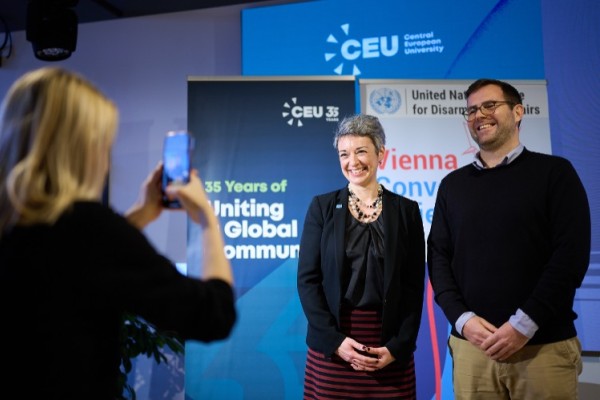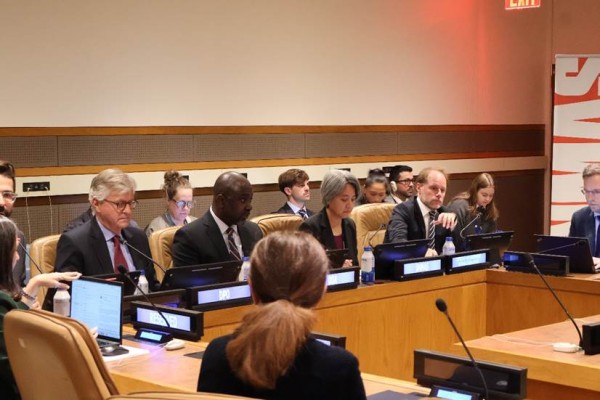
In a dynamic effort to strengthen global security through education and collaboration, experts and officials gathered in Vienna to spotlight the transformative role of United Nations Security Council Resolution 1540. On 28 November, the Vienna Center for Disarmament and Non-Proliferation (VCDNP), the United Nations Office for Disarmament Affairs (UNODA), and the Permanent Mission of Türkiye to the United Nations in Vienna co-organized a panel discussion to explore the educational and capacity-building impact of resolution 1540.
In his opening remarks, Ambassador Levent Eler, Permanent Representative of Türkiye, emphasized the importance of raising awareness of Resolution 1540 and shared Türkiye’s experience as an enabler of capacity-building efforts for neighboring countries, including Syria.
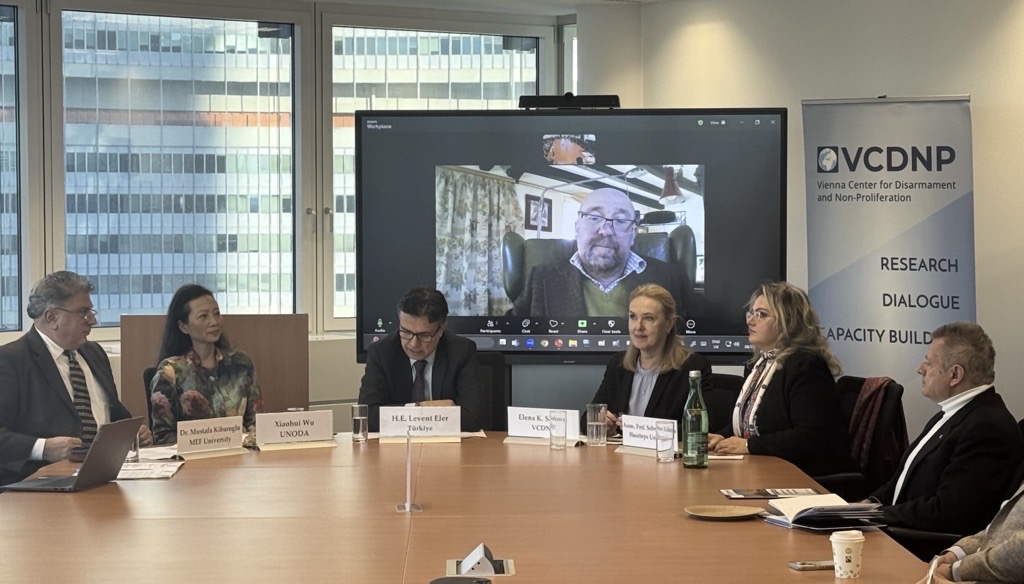
Among the panelists were Mustafa Kibaroglu, who has taught Resolution 1540 in Türkiye, and his former student Sebnem Udum, now an associate professor specializing in non-proliferation. Also present in the audience was one of Professor Kibaroglu’s recent PhD students. The presence “there generations” altogether at the event, underscored the enduring educational impact of Resolution 1540.
Matthew Healy shared Cranfield University’s short course on Resolution 1540 enforcement, developed in 2022. He emphasized the course’s collegial nature—not only as a tool for capacity-building but also as a “bond-building exercise”—highlighting Resolution 1540’s value as a uniquely cooperative framework for WMD non-proliferation.
The event’s host, VCDNP Executive Director Elena Sokova, highlighted the evolving international landscape since the adoption of Resolution 1540 and posed an important question: how can education on Resolution 1540 benefit from new technologies? She was among the contributors to UNODA’s online training course on Resolution 1540 developed years ago. Indeed, it is time to reflect, adapt, and progress.
Stressing Resolution 1540 as a model of international collaboration and a framework for cross-border efforts to address the threat of WMD proliferation, Xiaohui Wu, Head of UNODA’s 1540 Support Unit, emphasized the resolution’s strong focus on assistance—underscoring its continued relevance for more than two decades.
The audience engaged in vibrant discussions, reflecting a deep interest in the provisions of Resolution 1540 and its practical implementation—underscoring a shared commitment to advancing global security through collective action. The panel made it clear that building a solid foundation of education and capacity is essential for the effective implementation of Resolution 1540. By investing in knowledge and capacity, fostering collaboration, and embracing innovation, the international community can transform this landmark resolution into a lasting shield for global peace and security.