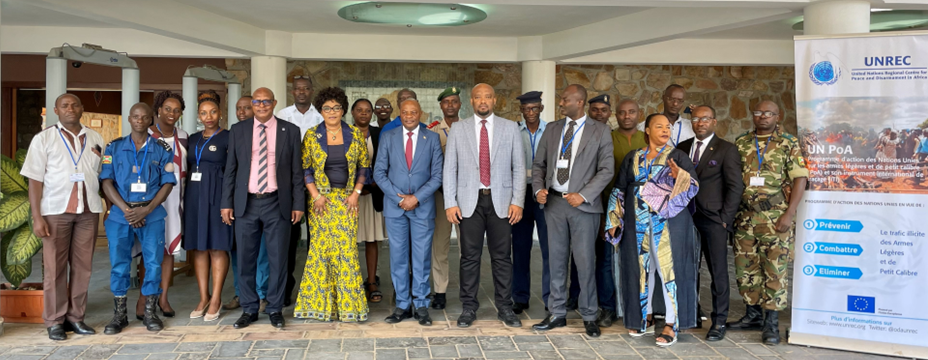
Bujumbura, 25 November 2025: In response to the security challenges posed by the illicit proliferation of small arms and light weapons (SALW) in the Great Lakes region, Burundi continues to strengthen its national arms control framework. In this context, a National Validation Workshop of the National Action Plan (NAP) to Combat the Illicit Proliferation of SALW was held on 25 November 2025 in Bujumbura, at the Hotel Club du Lac Tanganyika. The workshop brought together 25 participants, including representatives from the National Commission on SALW, relevant line ministries, defense and security forces (National Police, National Defense Force, Civil Protection), as well as civil society organizations actively engaged in SALW-related issues.
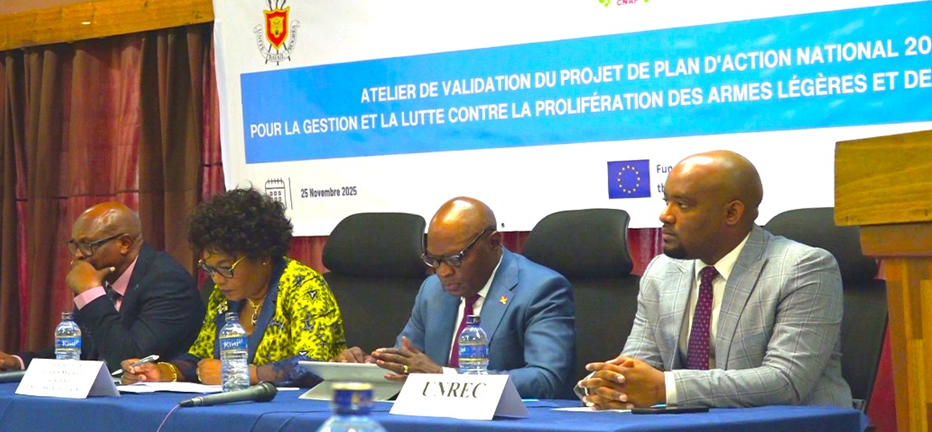
The workshop was opened by Representative of the Minister of Interior, Community Development, and Public Safety, the second Vice President of the National Commission on SALW, UN Resident Coordinator Office’ Chief of Staff, and the Director of UNREC.
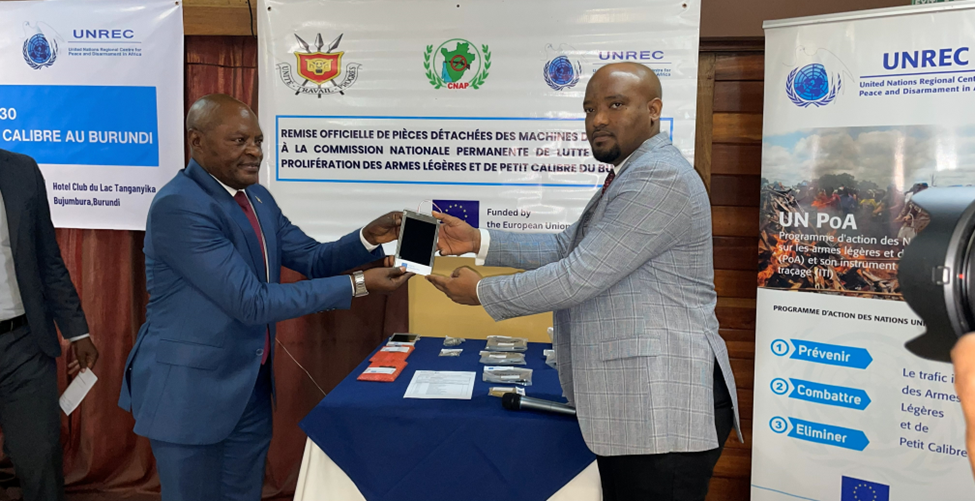
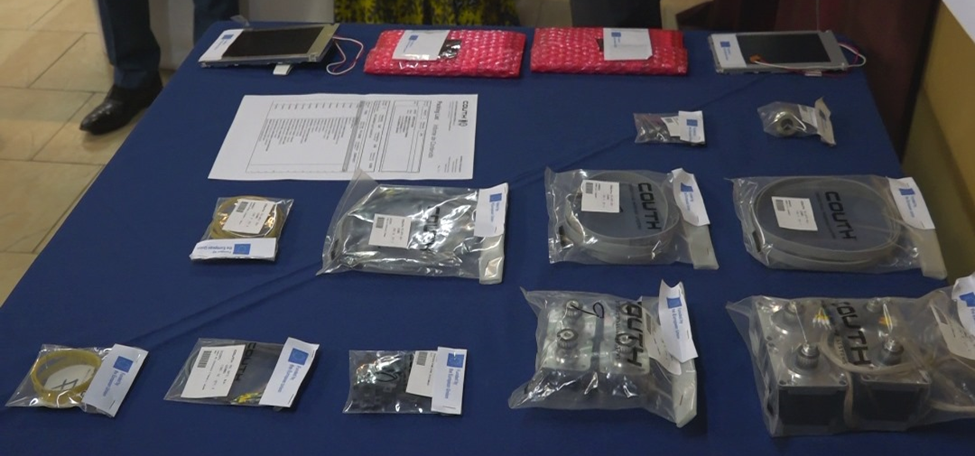
An official ceremony was held before the launching of the workshop’s discussions for the delivery of the spare parts of the marking machines purchased for the National Commission on SALW for the maintenance of 6 marking machines that were out of use.
The workshop itself was conducted within the framework of Burundi’s regional and international commitments, including the Nairobi Protocol, as well as initiatives led by the United Nations Office for Disarmament Affairs (UNODA), notably the Global Project (2023–2025) and the Modular Compendium of Small Arms Implementation (MOSAIC). Other key policy frameworks were also taken into consideration, including the Global Framework for Through-life Conventional Ammunition Management and the Women, Peace and Security Agenda.
Following a MOSAIC assessment and in-country assistance mission conducted by UNREC in December 2024, a consultant was engaged in April 2025, with the support of UNDP Burundi, to further assess the institutional capacities of the National Commission on SALW (CNAP) and to develop Burundi’s new National Action Plan. This process was informed by a series of inclusive bilateral consultations with national stakeholders and the National Commission, aimed at analyzing SALW dynamics in Burundi and shaping the NAP.
During the validation workshop, the draft National Action Plan was presented to national stakeholders for review and adoption. The consultant presented the strategic vision, priorities and proposed actions of the NAP, while participants provided comprehensive feedback and technical inputs to strengthen the document and ensure national ownership.
Discussions confirmed that the National Action Plan offers a coherent strategic framework and a set of concrete and actionable measures to effectively address SALW challenges in Burundi. At the conclusion of the workshop, national stakeholders formally validated the Plan, paving the way for its finalization and implementation.
The validation of the National Action Plan represents a key milestone in strengthening Burundi’s national SALW control architecture and reaffirms the country’s commitment to promoting sustainable peace and security in the Great Lakes region.
This mission was part of Phase II of the UN Programme of Action (PoA) and International Tracing Instrument project, funded by the European Union. Adopted in 2001, the PoA is a politically binding framework that supports States in controlling small arms through improved regulations, stockpile management, import/export controls, and international cooperation.