History
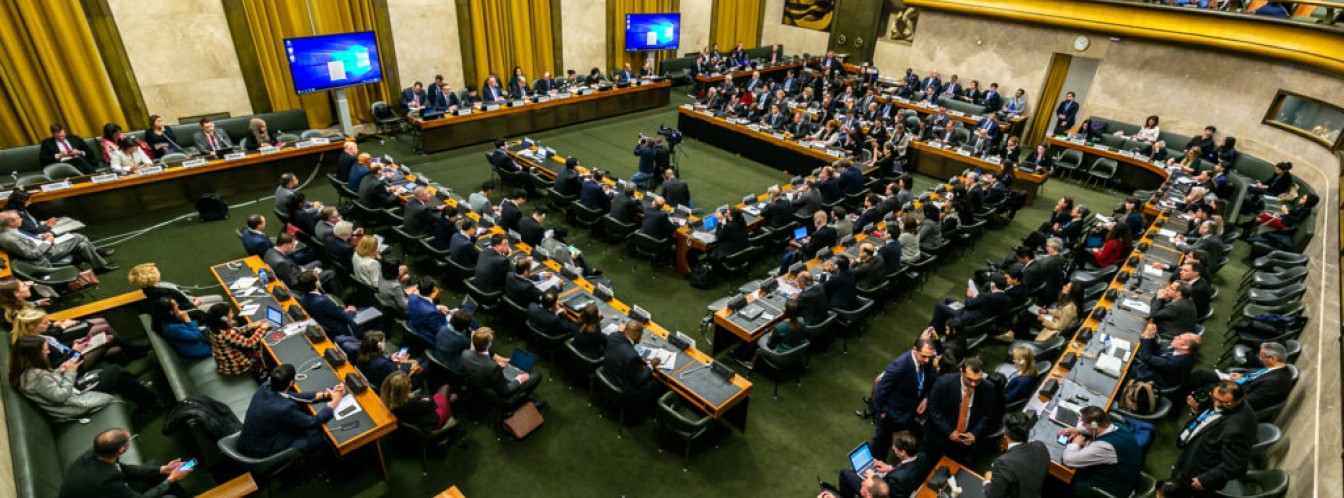
The Conference on Disarmament (CD), was recognized by the Tenth Special Session on Disarmament of the United Nations General Assembly (SSOD-I) (1978) as a single multilateral disarmament negotiating forum of the international community. It succeeded other Geneva-based negotiating forums, including the Ten-Nation Committee on Disarmament (1960), the Eighteen-Nation Committee on Disarmament (1962-1968) and the Conference of the Committee on Disarmament (1969-1978).
The CD and its predecessors have negotiated major multilateral arms limitation and disarmament agreements such as the Treaty on the Non-Proliferation of Nuclear Weapons, the Convention on the Prohibition of the Development, Production and Stockpiling of Bacteriological (Biological) and Toxin Weapons and on Their Destruction), the Convention on the Prohibition of the Development, Production, Stockpiling and Use of Chemical Weapons and on Their Destruction and Comprehensive Nuclear-Test-Ban Treaty.
Agenda items of the CD
Since 1997, the CD has considered the following agenda items:
- Cessation of the nuclear arms race and nuclear disarmament.
- Prevention of nuclear war, including all related matters.
- Prevention of an arms race in outer space.
- Effective international arrangements to assure non-nuclear-weapon States against the use or threat of use of nuclear weapons.
- New types of weapons of mass destruction and new systems of such weapons; radiological weapons.
- Comprehensive programme of disarmament.
- Transparency in armaments.
Work of the CD
The Conference is comprised of 65 member States, including the nuclear weapon States and 60 other States. In addition, every year, non-member States participate, upon their request, in the CD’s work. Their number reached 50 in 2019, the highest in 20 years.
The CD meets in an annual session, which is divided into three parts of ten, seven and seven weeks, respectively. The first week begins in the penultimate week of January. The CD is presided by its members on a rotating basis. Each President presides for a period of four weeks. In addition to formal and informal plenary meetings, since 2006, an informal coordination mechanism between the six Presidents of the year, in addition to the last President of the preceding year and the first President of the forthcoming year, helps to coordinate the work of the Conference.
The CD adopts its own Rules of Procedure and its own agenda, taking into account the recommendations of the General Assembly and the proposals of its member States. The CD conducts its work by consensus. It reports to the General Assembly annually, or more frequently, as appropriate.
The Director-General of the United Nations Office at Geneva, Ms. Tatiana Valovaya, is the Secretary-General of the Conference on Disarmament, and she also acts as the personal representative of the United Nations Secretary-General. Staff members of the United Nations Office for Disarmament Affairs Geneva Branch provide substantive and secretariat support to the CD.
Further resources
- Please consult the CD 2026 Meetings Place website for information pertaining to the 2026 session of the Conference.
- Please consult the CD Meetings Place website for information on CD Sessions between 2004 and 2025.
- Documents and records of CD sessions prior to 2004 can be found in the United Nations Digital Library.