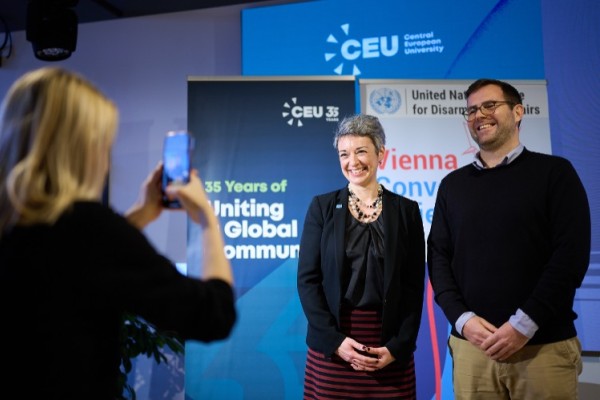
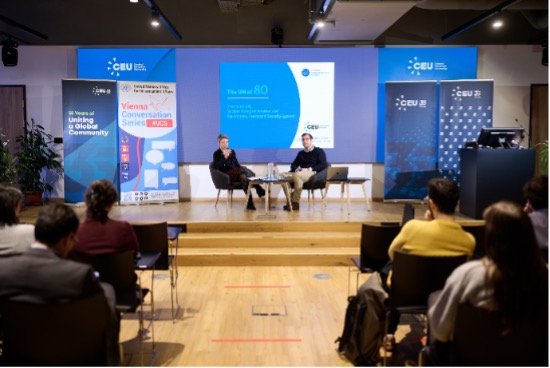
Marking eighty years since the United Nations adopted its first General Assembly resolution on nuclear disarmament, the UNODA Vienna Office and the Central European University (CEU) co-hosted a landmark edition of the Vienna Conversation Series. The event offered a space to reflect on the past, present and future of multilateral disarmament, nuclear non-proliferation and arms control issues, as well as their linkage with other agendas in an era of growing global uncertainty.
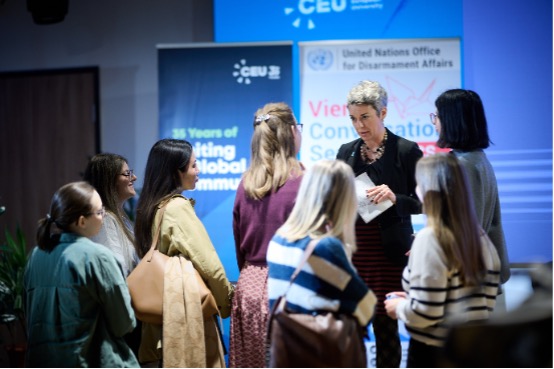
Held in a hybrid format, the event brought together a diverse audience, including many students and young professionals. Their thoughtful and well-informed questions on disarmament and current geopolitical trends enriched the discussion. Rebecca Jovin, Chief of the UN Office for Disarmament Affairs in Vienna, shared her personal journey and the motivations behind her long-standing commitment to disarmament, illustrating how diverse career paths can contribute to global peace.
Drawing on her extensive experience, she engaged the audience by linking personal motivation with global impact. She underscored the continued relevance of the Women, Peace and Security agenda and highlighted the importance of gender equality within the field of disarmament.
Revisiting the UN's Founding Mission and Today's Challenges
The conversation provided an opportunity to reflect on why and how the United Nations was founded 80 years ago. Since its inception, disarmament has remained central to the UN’s mission.
Participants highlighted the modernization of strategic nuclear arsenals, alongside rising risks of military escalation, as urgent drivers for renewed arms control and disarmament efforts. At the same time, the impact of conventional weapons on civilians and the emergence of dual-use technologies, such as autonomous weapon systems and cybersecurity threats, underscore the need for effective regulation.
Rebecca Jovin emphasized the UN’s essential role in encouraging States to engage in dialogue, protect and uphold existing frameworks and address emerging threats. In this context, the UN’s normative function remains an indispensable tool for advancing international security and humanitarian principles.
The Role of Education and Youth in Disarmament
The significant role that civil society, including youth and women’s organizations, have historically played in advancing disarmament and diplomacy was also discussed.
Educational tools and initiatives implemented by UNODA, particularly through its Vienna Office, were highlighted as key mechanisms to inform, educate, and empower young people in the field of disarmament. Rebecca Jovin presented specific opportunities available to youth, including through UNODA’s flagship Youth4Disarmament umbrella, as well as more targeted learning and empowerment programmes to equip future leaders with the knowledge, skills, and networks needed to support global disarmament efforts.
The event sparked a lively exchange, with participants raising pertinent questions about the upcoming NPT Review Conference, rising global military expenditures, emerging technologies, UN reform efforts and other topics.
A Call to Action
The Vienna Conversation Series offered a meaningful platform to reflect on disarmament's achievements and ongoing challenges, while also looking ahead to the future. The discussion reaffirmed that disarmament is not only a matter of international security, but also a humanitarian imperative that requires the active engagement of broad stakeholders to build a safer and more peaceful world.
Held at the CEU Auditorium on the university’s Vienna campus, the event was moderated by Patrick Labuda, Assistant Professor at CEU
To watch the event recording, click here. The audio podcast version is available on Spotify and Apple Podcasts.