Military AI, Peace & Security (MAPS) Dialogues, Geneva Side Event
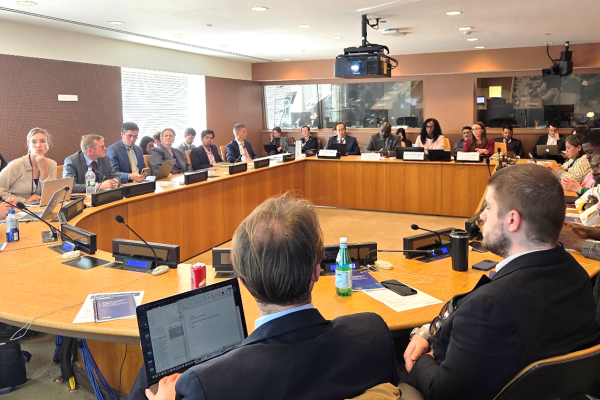
The following is a non-exhaustive summary of the key elements that emerged from the side event “An Interactive Dialogue on an AI Diplomatic Toolkit,” held in Geneva on 16 June 2026 alongside the UN informal exchanges on artificial intelligence in the military domain (Geneva, 15-17 June 2026). The side event was convened by the UN Office for Disarmament Affairs (UNODA), with support from the Republic of Korea, as part of the Military AI, Peace & Security (MAPS) Dialogues. It was open to representatives of States, international and regional organizations, civil society, the scientific community, and industry.
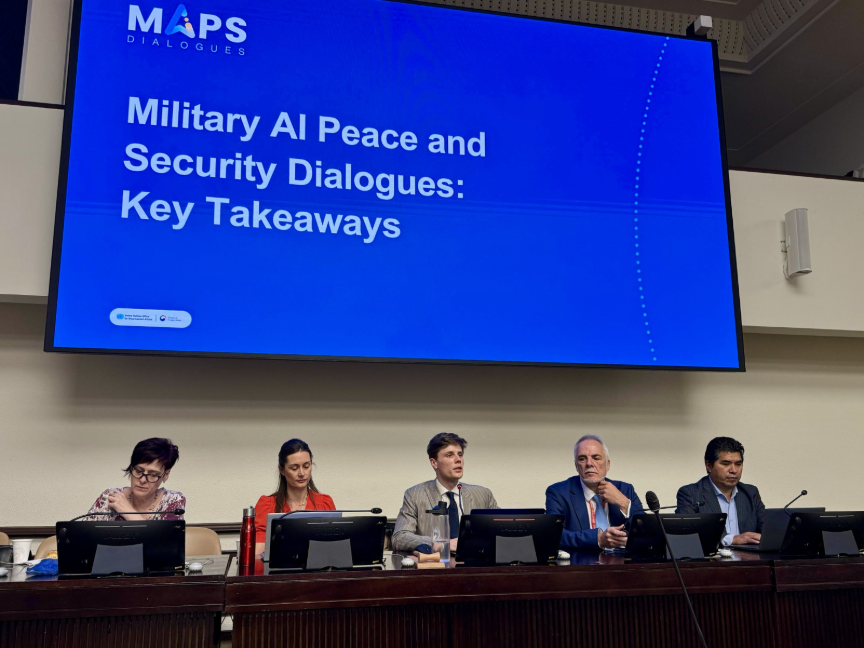
Building on the MAPS Dialogues activities of 2025 and 2026, UNODA gauged interest in developing a user-friendly AI Diplomatic Toolkit to support delegations in their deliberations on AI in the military domain (AIMD). The event represented a working conversation: a short briefing by UNODA on the takeaways of the MAPS Dialogues, reflections from four discussants, and an open exchange with participants. The discussion followed three themes: priority topics, content and scope; constraints and bottlenecks; and the nature, format and depth of a possible toolkit. The session was moderated by Ulysse Richard (UNODA).
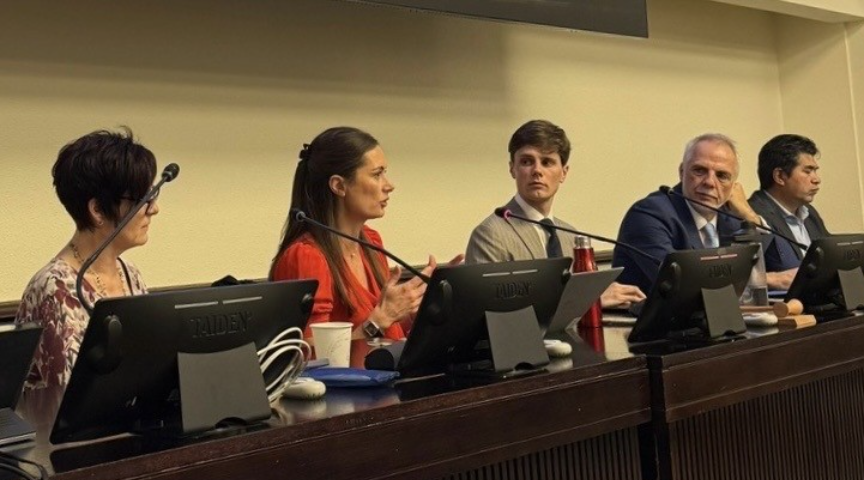
The reflections were delivered by Ambassador Alexander Kmentt, Permanent Representative of Austria to the United Nations Office at Geneva; Kerstin Vignard, Research Scholar on Science, Diplomacy and Technology Policy at the Institute for Assured Autonomy and Senior Analyst at the Applied Physics Laboratory at Johns Hopkins University; Georgia Hinds, Legal Adviser at the International Committee of the Red Cross (ICRC); and Raúl Salgado Espinoza, Professor of International Relations at FLACSO Ecuador.
1. Priority topics, content and scope
Discussants and delegations agreed that the issue space is wide and that a first task for any toolkit, and for the MAPS agenda more broadly, is to scope and map it. Ambassador Kmentt argued that a structured approach across different use cases would help States orient themselves in the debate and endorsed a risk-based approach drawing on the distinction between “upstream” and “downstream” applications, that is, the proximity of a given AI application to the use of force. For example, support missions do not carry the same challenges as command and control systems linked to targeting and engagement, and a toolkit can reflect those differences.
Georgia Hinds (ICRC) supported a risk-based structuring around themes or use cases, and offered the ICRC's own framing of three priority use cases that raise the greatest concern: AI in military decision-making, AI in weapon systems (in particular its links with autonomous weapons), and AI in cyber. She suggested that a toolkit could help articulate what has happened across different processes, given that many relevant questions have already been addressed elsewhere, including in discussions on information and communication technologies, on autonomous weapons systems, and in the Human Rights Council. Mapping across these venues, she argued, would help break down silos and avoid reinventing concepts and discussions that already exist.
Several speakers and delegations suggested that the toolkit could serve as a repository of Member States' positions. Georgia Hinds pointed to the Automated Decision Research website, which maps State positions on autonomous weapons, and suggested that a comparable resource for AIMD would be useful, with particular attention to surfacing positions that are currently less visible or less easily accessible, including those expressed in languages or from regions that are under-represented in the readily available material. A delegate similarly pointed to the value of a repository of national AI policies and international strategies, and of statements made by States during specific sessions, and cited a UNIDIR paper on confidence-building measures that drew usefully on comparisons with other policy fields.
On directories and expert access, both Ambassador Kmentt and Raúl Salgado Espinoza underlined the need to connect delegations with technical and operational insight. Ambassador Kmentt stressed the value of continued support for academia and civil society in monitoring and tracking AI developments, capabilities, deployments and impacts, alongside engagement with industry and militaries that bear responsibility for the use of force. Raúl Salgado Espinoza called for a list of companies and industries developing military AI applications and for an accessible directory of experts, drawn from industry, academia and civil society, with deliberate inclusion of specialists from the Global South who can speak first-hand to the needs, risks and capacities of their regions. Ambassador Kmentt also suggested that research on lessons learned from previous processes and instruments, including options for moving forward, would be useful as part of the mapping exercise.
2. Shared language and the place of a lexicon
Language emerged as a cross-cutting theme. Kerstin Vignard argued that a shared set of working definitions would be highly useful, but that producing it should not fall to States. She suggested that institutions such as UNODA and UNIDIR are well placed to compile working lexicons, which would allow delegations to converse without being bound by negotiated terminology, and would move faster precisely because it would not be a negotiation. She drew on the precedent of cyber, where calls for a negotiated lexicon persisted for years even as substantive progress was made without one.
Raúl Salgado Espinoza reinforced the point that the same words can carry different meanings, and noted that new concepts are often created within engineering communities and lost in translation before they reach decision-makers. He framed close involvement of the private sector as essential to keeping diplomatic language aligned with the evolving technology. A delegate added a multilingual dimension, observing that interpretation and translation across languages can produce divergent understandings of key terms, citing “security” as an example, and cautioned that not everything translates cleanly from English.
Another delegate welcomed the discussion on the relationship between lexicon nd policy progress, pointing to cyber as an example of common understandings built incrementally over time, and suggested that this experience is worth emulating.
3. Constraints and bottlenecks
Discussion of bottlenecks centered on the capacity of smaller delegations and those from developing countries. Raúl Salgado Espinoza and a delegate both observed that such delegations often arrive with limited time, bandwidth and technical background, and struggle to cover multiple fast-moving areas at once. In her closing remarks, Beyza Unal (UNODA) underscored that this constraint is the core motivation for the toolkit: in UNODA's exchanges, developing countries have repeatedly asked where they can find the information they need to participate on an equal footing.
Speakers also pointed to the difficulty of keeping pace with rapid technological developments and with a fragmented landscape of initiatives and processes. Ambassador Kmentt noted that monitoring innovation, capability development, deployment, and the impact of use is challenging and that sustained support for academia and civil society is needed to underpin monitoring and tracking. A delegate called for a mechanism to track outcomes across different processes, so delegations can see how developments in one venue affect their work in another.
A specific gap raised by Georgia Hinds (ICRC) concerned procurement. She reported that, in recent ICRC discussions on AI in military decision-making, States have expressed feeling daunted by the prospect of testing and benchmarking systems they did not develop themselves, having acquired them off the shelf, from commercial providers, or through transfer. Knowledge about procurement practices, she suggested, is an under-studied area that diplomatic discussions rarely reach, and one where the toolkit could usefully assemble good practices.
A researcher presenting findings on testing and evaluation (T&E) standards and benchmarks reinforced these concerns. The research found no shared terminology for T&E within industry itself; no shared benchmarks or terminology across the States examined, drawing on case studies of the United States, the United Kingdom and Australia; and a gap between States and vendors. The researcher suggested that UNODA take these gaps into account and recognize that cultural and linguistic factors shape how standards and terms are understood.
4. Nature, format and depth
On format, there was broad interest in a practical, easy-to-use resource. Responding to a criticism that ODA does not have the mandate to develop such a toolkit, Beyza Unal (UNODA) indicated that the toolkit is envisaged primarily as an interface, a searchable resource where a user could enter a concept, such as “lifecycle,” and be directed to relevant statements from different States, saving time and making information easy to find. She emphasized that it is intended neither as a terminology exercise nor as an analytical tool.
Speakers offered concrete reference points. Ambassador Kmentt valued interactive and easy-to-use websites such as UNIDIR’s AI Policy Portal, and considered platforms for exchanging best practices on national measures, regulation and legislation to be essential, noting that the informal exchanges and the Responsible AI in the Military Domain (REAIM) conferences are a start, but that more specific and inclusive venues are still needed. Georgia Hinds cited the Automated Decision Research website. Raúl Salgado Espinoza proposed a repository of short explanatory videos on legal and technological issues that delegates, particularly from smaller delegations, could access easily, including on the move, and that could be hosted on partner institutions' websites.
The delegations of Pakistan and France both emphasized the value of primers: short, accessible introductions to the topic, including technical primers for delegates without a technical background. Georgia Hinds and the French delegation returned to the importance of surfacing less accessible and non-dominant positions and of remaining mindful of multilingual differences in how key terms are understood.
6. Next steps
UNODA reiterated that the toolkit remains a concept in its early stages and invited Member States and stakeholders to continue sharing their views. The Office will continue to build on the MAPS Dialogues and on the input gathered during the informal exchanges in Geneva as it considers whether and how to take the toolkit forward.